The Future of Warehousing: Preparing Your Workforce for AI and Automation

The warehouse automation market is expected to grow at a compound annual rate of around 20 percent by 2030.¹ This, along with the implementation of other tech tools, is quickly evolving the warehouse sector. Processes continue to change as new machines are incorporated into business workflows.
As an employer, how can you ensure your business is ready for the future of warehousing? The key is to prepare your workforce by equipping them with important skills. To help you, this article will dive into effective reskilling and upskilling tips you can implement within your teams.
Automation in Warehousing
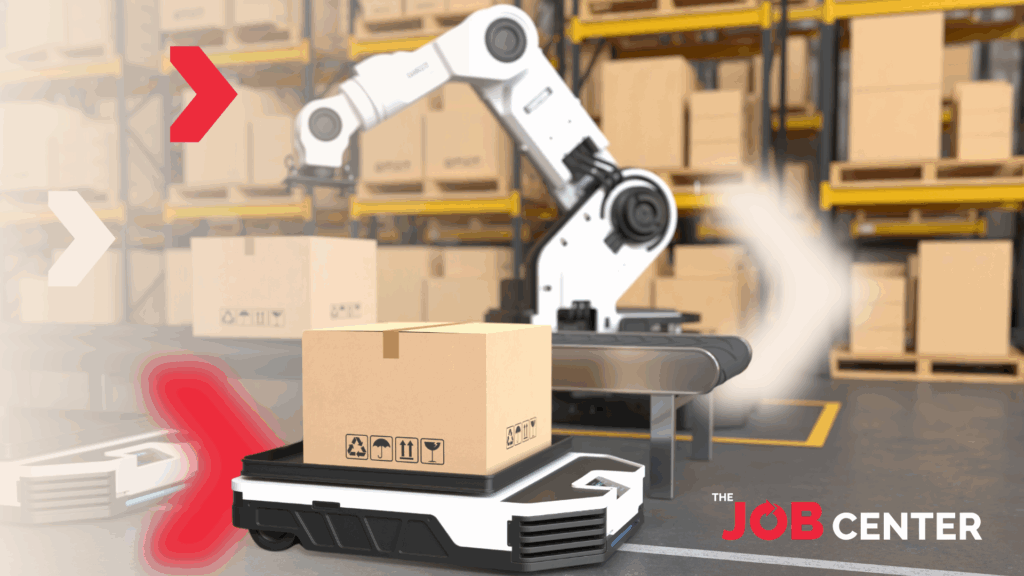
Many modern warehouses utilize Automated Guided Vehicles (AGVs) that follow predetermined paths. Some also use Autonomous Mobile Robots (AMRs) that navigate independently to transport goods throughout facilities. Beyond transportation, businesses implement AI-powered systems to improve how their organization manages inventory and optimizes storage arrangements.
These innovations have significantly affected warehouse professionals. It has eliminated some traditional roles like basic order picking and manual inventory counting. Despite technology accomplishing the responsibilities of specific positions, it’s also creating new roles for professionals—most of which are focused on technology supervision, maintenance, and data analysis.
A Balance of Technology and Human Expertise
Finding the right balance between technology and human expertise is crucial in modern warehousing operations. While automation and AI-powered systems dramatically increase efficiency and accuracy, warehouses that rely exclusively on technology risk creating inflexible operations. This may cause struggles in adapting to unexpected situations or unique customer requirements.
Human workers bring invaluable critical thinking, problem-solving abilities, and contextual understanding that even the most advanced AI systems cannot replicate. When warehouse professionals are undervalued or excluded from critical processes, companies may experience difficulties in areas that require human insight.
The most successful warehousing operations integrate technological solutions with human expertise. For example, they use automation to handle repetitive, physically demanding tasks while empowering workers to focus on complex decision-making and process innovation. This balanced approach creates resilient workflows, where technology handles routine work while skilled employees manage exceptions.
Read more: How to Stay Ahead in the War for Talent: Staffing Solutions that Give You a Competitive Edge
3 Skills of a Future-Ready Workforce
Smart warehousing requires professionals who are capable of handling machine learning systems and artificial intelligence. Beyond the usual qualifications, they need to develop new skills that are relevant to a technology-driven future. Some examples of these are as follows:
1. Digital Literacy
Data literacy has become essential for warehouse employees who must now understand how to access, read, and work with digital information across various platforms and systems. Workers need basic skills in using warehouse management systems and understanding data collection points. They also need to learn how information flows through the supply chain to perform effectively in increasingly digitized environments.
2. Data Interpretation
These skills, coupled with soft skills like critical thinking, enable warehouse staff to make sense of the vast amount of information gathered by automated systems and transform it into actionable insights. Employees must learn to analyze inventory reports, efficiency metrics, and performance data to identify patterns vital to their work. This can also help them spot anomalies that require attention and make informed decisions that improve overall warehouse operations.
3. Process Optimization
Knowledge of process optimization enables warehouse workers to identify bottlenecks, eliminate waste, and recognize areas for improvement. When combined with technological efficiency, this can lead to practical operational experience and added value to the organization. Staff members who understand both automated systems and workflow dynamics can propose meaningful adjustments that boost productivity, making the entire operation more responsive to changing demands.
4 Tips for Effective Reskilling and Upskilling
Your organization needs to go beyond simply offering reskilling and upskilling opportunities. To drive your workforce towards success, it’s best to consider the following tips for effective skill acquisition:
1. Align Skills with Future Needs
Your warehouse needs to develop skills that will matter tomorrow, not just today. This ensures that your workforce development efforts address genuine operational requirements rather than wasting resources on outdated capabilities.
Your business must identify emerging technologies and processes that will shape its warehouse operations in the coming years. To prepare employees specifically for these changes, begin by analyzing industry trends. Consult with technology providers to understand upcoming innovations in automation and AI. It’s also wise to map out the specific competencies your warehouse will require in the next three to five years.
Create detailed skill matrices that connect current job roles to future requirements. The goal is to accurately identify gaps that need addressing. Develop personalized learning paths for different employee segments based on their current roles and potential future positions. Remember that employees will engage more enthusiastically with training when they clearly understand how new skills connect to their job security and career advancement.
Read more: How to Retain Top Performers in High-Turnover Roles Without Breaking the Budget
2. Offer Job-Relevant, Hands-on Training
Hands-on training is more effective than lectures or online modules when it comes to building warehouse skills. Your employees need practice with real tools and situations they may face daily. By offering job-relevant training where professionals can practice actual skills, you’re improving retention of information and motivation to learn.
Abstract concepts without clear workplace applications often fail to translate into improved performance. So, you need to design training modules that directly mirror real warehouse scenarios. Create sandbox environments where workers can experiment with new processes, technology, or workflows without affecting actual production.
If possible, implement mentor-apprentice arrangements that allow experienced staff to guide others through complex tasks during regular shifts. Break down comprehensive skills into manageable components that can be mastered progressively.
To prepare for the future in warehousing, teach your employees skills they will potentially need, like predictive analytics or automation.
3. Incorporate Digital Tools into Workflows
Many warehouse workers, particularly long-term employees, may feel intimidated by new technologies if introduced too abruptly or without proper support. It’s important to integrate digital tools into daily workflows to help employees gradually build familiarity. This can lessen resistance and build confidence with systems they need to master.
How can this be done?
- Start small. First, introduce simple digital tools that enhance rather than complicate existing processes. For example, you can deploy mobile devices for inventory checks before implementing fully automated systems.
- Make it easy. Create user-friendly interfaces that minimize complexity while introducing workers to digital concepts. You can also consider assigning technology champions from within the workforce to help peers overcome initial hesitation.
- Create a safe space to transition. Provide abundant practice opportunities with new systems before making them critical to daily operations. Design workflows where digital tools and traditional methods operate in parallel during transition periods.
Digital adoption happens most effectively when introduced as helpful assistance rather than an unwelcome disruption.
4. Promote a Culture of Continuous Learning
Learning can’t be a one-time event in modern warehousing. In a rapidly changing industry, fostering a culture of continuous skill development in your facility equips your workforce to adapt as warehouse technology advances.
Organizations with strong learning cultures experience less resistance to change and greater employee engagement. Here’s how to make this a reality for your organization.
- Dedicate learning time slots specifically for upskilling activities across all warehouse departments.
- Create clear connections between learning new skills and career advancement opportunities within the company. This will help motivate your people to put in the extra effort of mastering new skills.
- Develop internal certification programs that recognize progressive skill acquisition with tangible benefits.
- Share success stories of employees who have successfully transitioned to new roles through learning initiatives within your company.
You can also incorporate learning goals into performance reviews and compensation structures. This can help drive motivation to learn and improve.
Equip your smart warehouse with a skilled and competent workforce.
The best way to ensure success is to build a workforce that is equipped with the capabilities necessary for the future of warehouse management. Instead of relying simply on training, we at The Job Center Staffing are here to offer our services and expertise.
As a staffing firm that specializes in warehouse, distribution, and other general labor positions, we have the knowledge and experience to help you create future-ready teams. Our team understands your unique needs and delivers tailored solutions to drive your success.
Want to learn more? Contact us or download our app today!
Reference
- “U.S. Warehouse Automation Market Size & Outlook, 2024-2030.” Grandview Research, 2024, www.grandviewresearch.com/horizon/outlook/warehouse-automation-market/united-states.

About
Joey Stoller
Other articles